
Steam's September GPU Survey Shows RTX 5060 Growth
Desktop RTX 5060 and 5060 Ti shares rose, while the laptop entry moved in the opposite direction.


Steam's September GPU Mix
Steam's September 2026 hardware survey shows stronger representation for two desktop RTX 50 models. The RTX 5060 reached 4.20%, up 1.22 percentage points, while the RTX 5060 Ti reached 3.87%, up 1.46 points. The RTX 5060 Laptop GPU was listed separately at 2.33%, down 0.17 points.
Read the Change Column Correctly
These figures come from Valve's monthly hardware survey, whose participation is optional and anonymous. The changes describe shares of the survey, not quantities sold. A percentage-point increase is an addition to a share, not an equivalent percentage increase in shipments.
That distinction prevents a familiar mistake: treating a larger slice of one month's sample as a direct measurement of what shoppers bought that month. The table cannot identify whether a particular machine is newly purchased, recently upgraded or simply appearing in the sampled population.
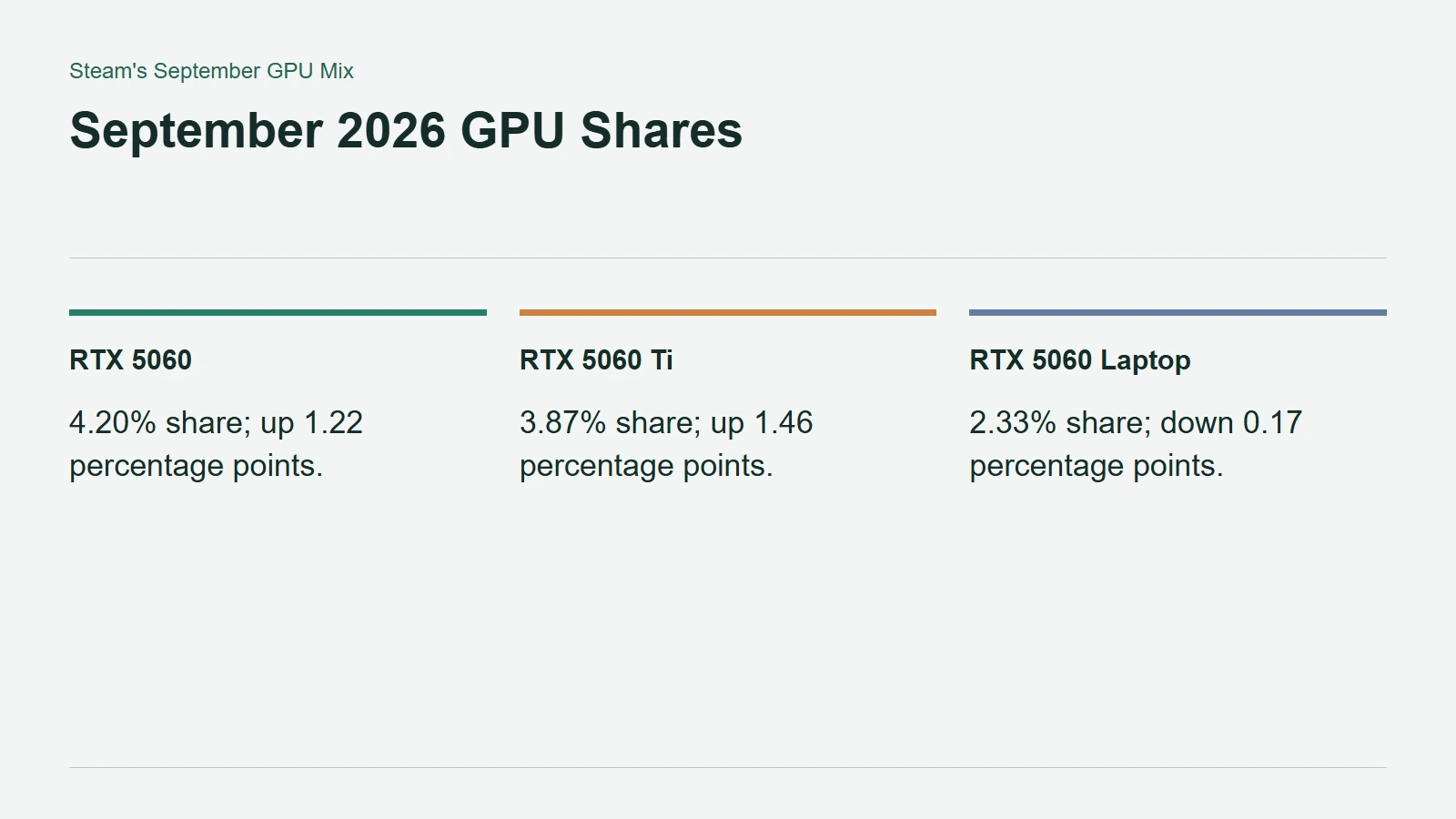
September 2026 GPU Shares
One Family Name Covers Different Hardware
NVIDIA's specifications give another reason to preserve the model names. The desktop RTX 5060 has 3,840 CUDA cores and 8GB of GDDR7 memory. The RTX 5060 Ti has 4,608 cores and is offered with either 8GB or 16GB. A model name alone therefore does not always identify a unique memory configuration.
The laptop RTX 5060 is different again: NVIDIA lists 3,328 CUDA cores, 8GB of GDDR7 and a range of boost clocks. It is not simply a desktop card moved into a smaller case. That makes combining similarly named desktop and mobile products a poor shortcut when discussing the performance players can expect.
Core counts themselves are not an FPS comparison. They help establish that these are distinct products, but a purchasing decision still needs tests of the exact card or laptop, at relevant settings and resolutions.
A Useful Snapshot, Not a Shopping Verdict
For buyers, the sensible order remains budget, game requirements and independent performance evidence, followed by the practical details: memory capacity, power, cooling and physical fit. Popularity cannot answer whether a card will suit an existing system.
The survey is useful context for the hardware landscape, not a substitute for that work. Keep the product labels intact and resist turning a movement in usage share into an explanation of why it happened. A chart can show a change without identifying its cause.