
Steam Playtest, Demos, and Early Access Are Different: Here's How
A request to test, a playable sample, and a purchase of an unfinished game carry different expectations.


Steam Access Types
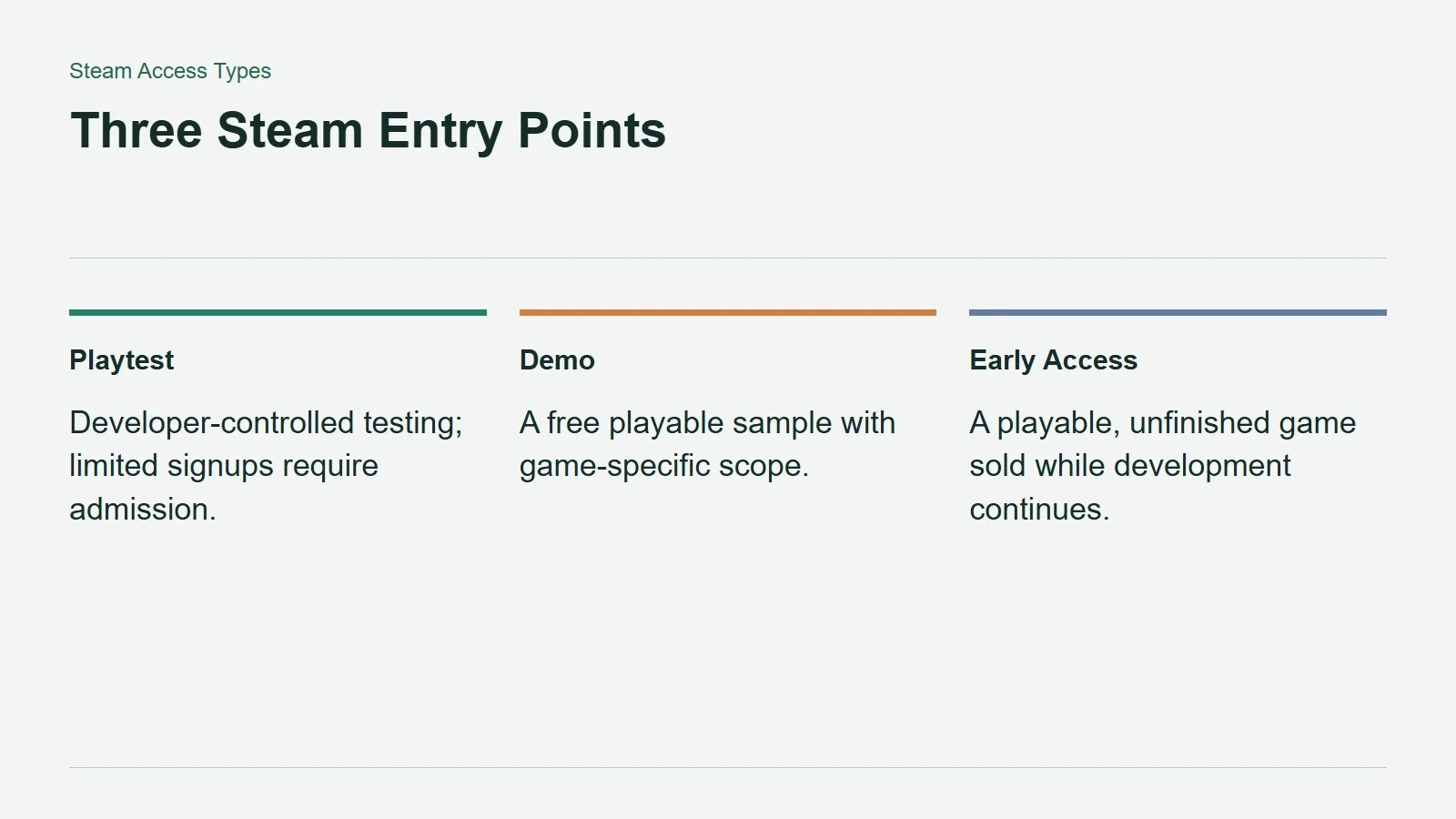
Three Steam pages can offer an early look at a game while promising very different things. Steam Playtest manages testing access, a demo offers a sample, and Early Access sells a playable game that is still being developed. Understanding the label helps avoid treating a signup as a purchase or a test build as a release.
Playtest Requests Are Not Guaranteed Invitations
Valve's Steam Playtest documentation gives developers control over admissions and availability. Under limited signup, requesting access puts a player into the pool from which testers are admitted. It is not a promise of an immediate download.
Developers can instead use open signup, which automatically accepts requests. They can also distribute Playtest keys. The experience therefore depends on the configuration and the studio's testing plans, not merely on the presence of a signup button.
A Playtest can be deactivated when testing ends. That is an important difference between being allowed into a particular experiment and expecting permanent access. Read the developer's stated test window before setting aside an evening with friends.
Three Steam Entry Points
A Demo Is a Sample With Its Own Scope
Steam's demo documentation describes free playable portions intended to let customers try a game. There is no universal duration or requirement that every major system appear. A focused level can show the core mechanics without demonstrating the full campaign or endgame.
Demos have a separate application identity associated with the full game. Valve provides ways for developers to share save data, but that is an implementation option, not a promise that every demo's progress carries forward.
Check the demo's description for its boundaries. A polished opening chapter might answer whether movement feels right while leaving long-term progression unknown. Conversely, a limited sample should not be judged as though it promised the entire product.
Early Access Is a Purchase of the Current Game
Valve defines Early Access as selling a playable, unfinished game while development continues. Its guidance says the current build should justify its value. The decision is therefore whether the game available now is worth buying, not whether the most ambitious roadmap would be worth the price someday.
Early Access is also distinct from a preorder, which delivers the game later. Steam uses Advance Access for another arrangement: a preorder incentive that lets eligible buyers start before the standard release. Similar everyday wording does not make these the same programme.
Before clicking, identify what the offer actually grants: admission to a test, a free sample, or a purchased developing game. Then check availability, content, and progress-transfer details. The label sets the broad expectation; the specific game's terms tell you what you can play tonight.