
ASUS 24.5-Inch OLED Monitors: Four Esports Models Explained
The compact ROG lineup spans QD-OLED and Tandem WOLED, with refresh rates from 360Hz to 720Hz.

Compact ROG OLED
ASUS's 24.5-inch OLED range addresses a very particular upgrade: keeping a compact esports screen while changing the panel technology behind it. The lineup described in the company's August 25 Gamescom material includes four Full HD models, and their similar names conceal meaningful differences in refresh rate, panel construction and connectivity.
That makes this a model-selection problem before it becomes a discussion about whether OLED is worth buying. The fastest specification in the family does not belong to every screen carrying the Ace name.
Match the Model to the Panel
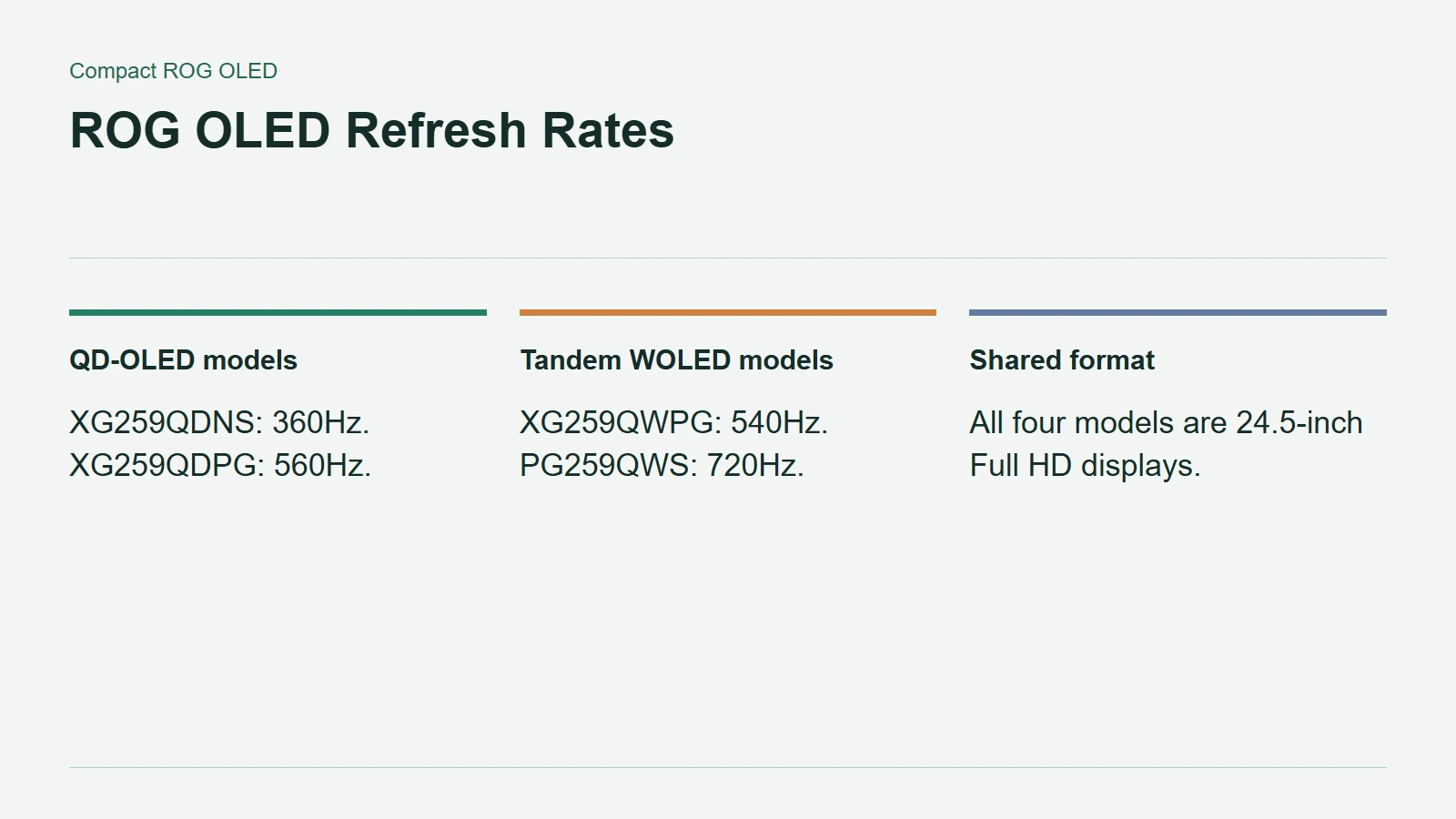
The two RGB Stripe QD-OLED options are the ROG Strix OLED XG259QDNS Ace at 360Hz and XG259QDPG Ace at 560Hz. The Tandem WOLED pair consists of the XG259QWPG Ace at 540Hz and the ROG Swift OLED PG259QWS Ace at 720Hz.
All four are 24.5-inch Full HD displays. Choosing between them therefore does not mean choosing a larger desktop or higher native resolution. It means weighing panel characteristics and speed within the same basic screen format.
ASUS's detailed lineup comparison also lists DisplayPort 2.1 UHBR20 for the PG259QWS, while the three Strix models use DisplayPort 1.4 with DSC. Check the exact model's connection table rather than borrowing a port specification from the flagship.
ROG OLED Refresh Rates
Response Time Is Not the Whole Delay
ASUS quotes 0.02 ms gray-to-gray response times for the Tandem WOLED models and 0.03 ms for the QD-OLED models. Those are manufacturer pixel-transition figures, not measured end-to-end latency from a mouse click to a visible result.
The company's explanation also separates pixel transitions from sample-and-hold blur, which comes from holding each image on screen until the next refresh. A fast pixel response does not make every other part of motion presentation disappear.
Higher refresh rates provide more display opportunities, but a game still needs to deliver frames consistently. A 720Hz screen cannot make an overloaded CPU finish a frame sooner. For CS2 or Apex players, examining frame-time consistency on the existing PC is a useful step before prioritizing the highest panel number.
Compact Size Remains a Preference
The appeal is straightforward for someone who already likes a small screen at their usual viewing distance. There is less reason to treat 24.5 inches as universally better for every desk or game.
Compare coating, connection requirements and the regional warranty as carefully as refresh rate. The announcement establishes a broader compact OLED choice; it does not establish local stock, an independent latency ranking or a guaranteed improvement in competitive results.