
Logitech PRO X3 LIGHTSPEED: What to Check Before Upgrading
The wireless headset puts microphone capture, adjustable sound and longer battery life at the center of its pitch.

PRO X3 Headset
Logitech's PRO X3 LIGHTSPEED is a wireless gaming headset, and its most useful upgrade questions concern communication and daily comfort rather than a competitive label. Introduced in the company's September 23 PRO lineup announcement, it combines revised microphone capture with adjustable audio and a longer advertised battery run time.
Those are practical features, but they solve different problems. A player whose current microphone clips callouts has a different reason to upgrade from someone who already uses a separate desk microphone.
Start With the Microphone and EQ
Logitech specifies a 48 kHz, 16-bit microphone and 50 mm PRO-G Graphene drivers. Its launch announcement also lists a 10-band parametric equalizer. The microphone figures describe capture capability; they are not an independent assessment of how your voice will sound after a chat application processes it.
The official headset page identifies an omnidirectional microphone, a detachable adjustable boom and BLUE VO!CE settings in G HUB. Placement and the surrounding room therefore deserve attention alongside the format on the box.
For a squad, the useful comparison is intelligibility. Can teammates understand a short call while game audio is busy? For listening, compare familiar game sounds at similar volumes before making large EQ changes. More adjustment bands give you control, not a universal preset that makes every game's footsteps equally clear.
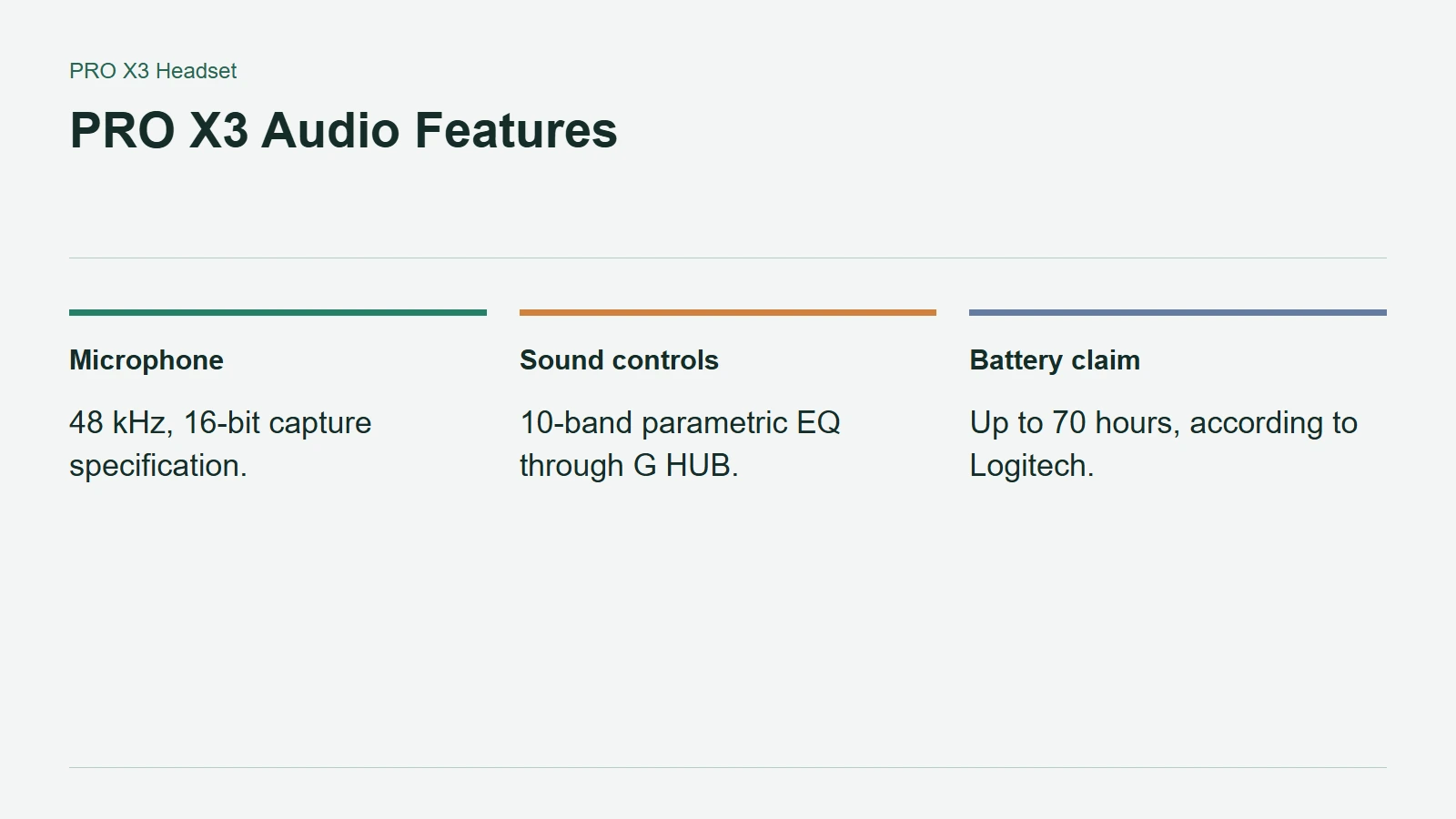
PRO X3 Audio Features
Wireless Convenience Has Several Parts
The product page lists LIGHTSPEED wireless and Bluetooth. Do not turn the presence of two connection names into an assumption that all mixing, microphone or platform features behave identically in both modes. Match the exact device and connection you use to the compatibility information before buying.
Logitech advertises up to 70 hours of battery life. Treat that as a manufacturer ceiling, not a guarantee for every volume level and usage pattern. The relevant question is whether it removes charging interruptions from your own routine.
Comfort Needs More Than a Materials List
Memory-foam ear cups and a perforated headband are part of the design. The product page describes leatherette or velour ear-pad options, but the materials alone cannot establish clamping pressure, heat buildup or the seal around glasses.
An upgrade makes most sense when it addresses a specific weakness in your present setup. Put microphone clarity, fit and the connections you need ahead of the series name. A headset can have a stronger specification sheet without being the better match for your head, room or existing audio equipment.