
Logitech's Pro X3 Superstrike: What Its Click Technology Changes
Adjustable actuation, reset and haptics give the mouse three separate ways to tune a click.


Pro X3 Superstrike Clicks
Logitech's Pro X3 Superstrike is built around a different idea of a mouse click: detecting button position and generating the tactile response separately. Its Haptic Inductive Trigger System, or HITS, lets players change when an input registers, how the button resets and how the click feels. Those are related controls, but they are not interchangeable.
Sensing the Press, Then Creating the Feel
Logitech's HITS technology explanation describes electromagnetic sensing in place of a conventional microswitch. Actuators provide haptic feedback. The actuation setting controls the travel needed to register a press, while rapid-trigger adjustment governs the reset behavior that makes another press possible.
The practical appeal is the separation of sensitivity from sensation. A player may want a short activation distance without the strongest tactile response, or a more deliberate press with clearer feedback. That flexibility is the feature; a particular setting is not automatically the right one for every hand.
Start conservatively and change one variable at a time. Otherwise, an uncomfortable session leaves three possible causes: the activation threshold, reset behavior or feedback level.
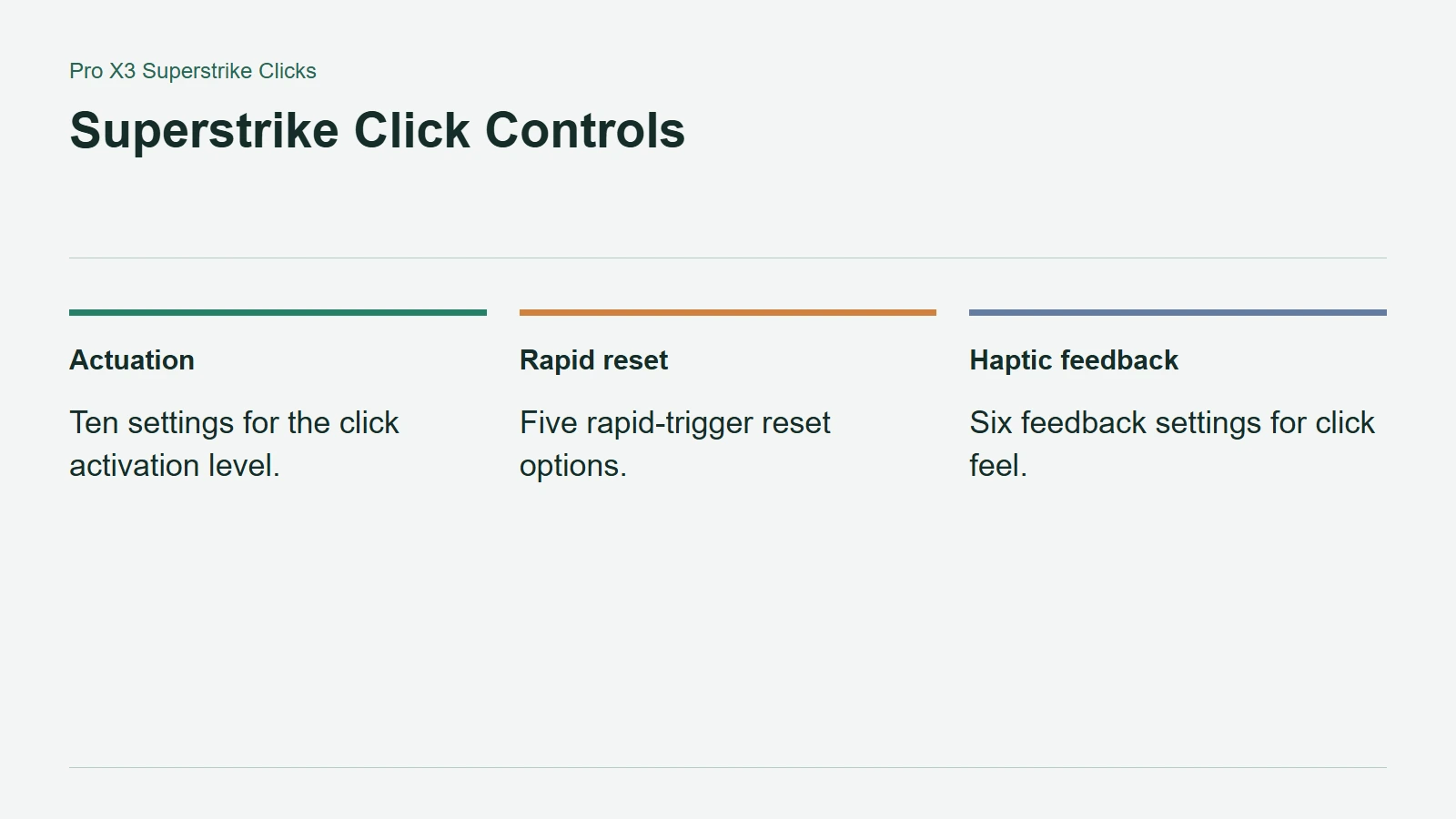
Superstrike Click Controls
What the X3 Adds Around HITS
In its development account, Logitech says the X3 uses a new NxLOGI chipset and supports 8kHz reporting over both wired and LIGHTSPEED wireless connections. The company also describes a lengthy refinement process with esports athletes, including changes to balance and component placement.
The September 23 launch announcement lists ten actuation levels, five rapid-trigger reset options and six haptic settings. These are concrete adjustment choices. They are more useful for understanding the product than assuming its PRO branding establishes a measurable advantage in every game.
Reporting frequency is also a different measurement from the time it takes a finger to activate the button. Raising one specification does not, by itself, describe the entire journey from physical movement to an on-screen response.
Speed Claims Still Need Context
Logitech advertises click-latency improvements for HITS, but manufacturer testing is not a personal result or a guaranteed reduction in reaction time. A meaningful comparison needs to identify the settings, test method and competing device, alongside the measurement being reported.
For a buyer, grip comfort and repeatable control should stay in the decision. Try to distinguish deliberate clicks from accidental ones when evaluating an aggressive configuration. The best reason to consider Superstrike is the ability to tailor the click, not a promise that its fastest setting will make every player more accurate.