Steam Trading Cards: What They Are, How to Get Them, and What They're Worth
What Are Steam Trading Cards?


steam trading cards
Your Steam inventory is probably full of trading cards you've never looked at. Some of them are worth a few cents. A few of them, depending on which games you've played, might actually be worth something. And at least one of them is almost certainly a foil card you've been holding onto because it feels special, even though you have no idea what to do with it.
This is everything you need to know about Steam trading cards, how the system works, how to get more cards, what separates a $0.03 card from a $134 set, and what you can actually do with all of it.
What Are Steam Trading Cards?
Steam trading cards are digital collectibles that drop while you play games on Steam. Each game with the system enabled has its own set of cards based on its characters, art, or themes. Collect a full set and you can craft it into a badge, which goes on your Steam profile and contributes to your account level.
That's the short version. The longer version is that the system launched in 2013 as a way to give players a reason to keep their Steam profile active, and it has since turned into a functional microcollectible economy where some cards trade at the price of a decent cup of coffee and others trade at the price of a disappointing sandwich.
Valve takes a 5% cut of every market transaction (on top of Steam's standard 10% marketplace fee). The community has adjusted for this. The sellers, not always.
Normal vs. Foil Steam Trading Cards: What's the Difference?
Every trading card set has two versions: normal and foil.
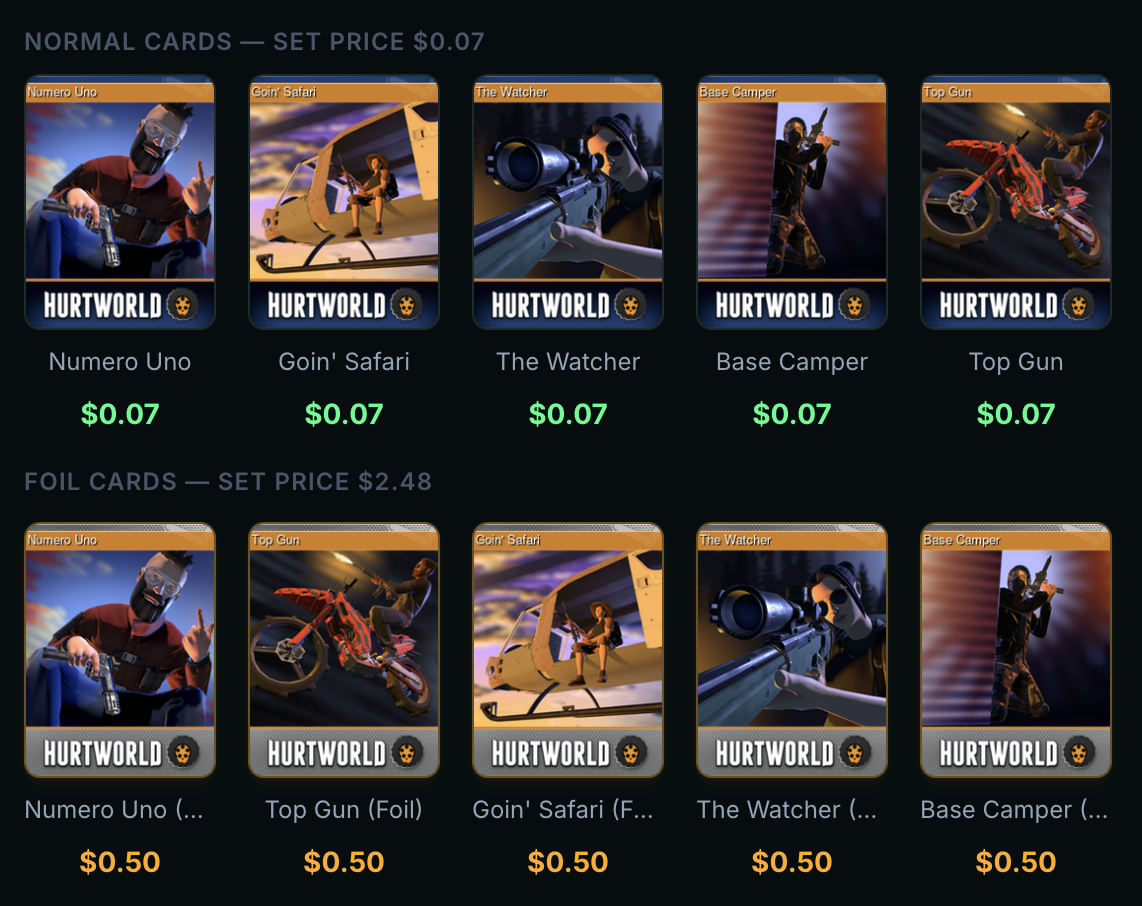
Normal cards drop while you play. Foil cards drop much less frequently, they're essentially rare variants of the same card, with a slightly different visual treatment. In practice, foil cards don't do anything different from normal cards. You can craft a foil badge the same way you craft a normal one, except the foil badge has a distinct look and comes with a foil-specific border on your profile.
The economic difference is more interesting. Foil cards are worth more than normal cards almost universally, simply because they drop less often and supply is lower. A normal card from a mid-tier game might sell for $0.05. The foil version of the same card might sell for $0.30. That ratio holds roughly across the market, though it collapses for very old or very unpopular games where neither version has meaningful demand.
For crafting purposes: you need one of each card in a set to craft a badge. You can only craft a normal badge from normal cards and a foil badge from foil cards. They don't cross over.
How to Earn Steam Trading Cards
Playing Games
The primary way to get cards is to play games that support them. When you launch a supported game, you become eligible to receive card drops, up to half the total card set for that game, rounded down. A game with eight cards in its set will drop a maximum of four cards to you.
The drops don't come at a fixed rate. They arrive roughly every 20–30 minutes of active playtime, but the timing is soft. You'll get all your drops eventually if you keep the game running. Running it idle in the background will also work (this is widely known and Valve has never stopped it).
Once you've claimed your half-set through play, you won't get more drops from that game. To complete a full set, you'll need to buy, trade, or earn the rest.
Booster Packs
After you've used up your card drops for a game, you become eligible for booster pack drops. Booster packs contain three random cards from that game's set (normal only), and they drop randomly to eligible players. Your chances increase the higher your Steam account level is.
Booster packs are also sold on the Steam Community Market, which makes them a faster route to completing a set than buying individual cards if the per-card math works out.
Buying Cards
The Steam Community Market lets you buy individual cards directly. Search for the game you're targeting, find the specific card you need, and buy it at the listed price. This is usually the fastest and most reliable method for completing a set.
You can also check all available Steam trading cards to browse what's out there before committing to a set.
How to Buy Steam Trading Cards
Go to store.steampowered.com/market, search for the game name plus "trading card," and you'll find every listed card with current prices. You can sort by price, buy immediately at the listed price, or place a buy order at a lower price and wait.
A few things worth knowing before you spend:
Prices fluctuate with Steam sales. During a sale, a lot of players are buying games and generating card drops, which increases supply and pushes prices down. If you're trying to sell cards, a sale is a bad time. If you're trying to buy, it can be a good one.
The market has a $0.03 floor. Cards can't be listed below three cents. This means the cheapest possible card still costs you three cents plus Valve's fee.
Completing a badge set almost always costs more than the badge is worth. The badge gives you XP, a profile background, emoticons, and a coupon. The coupon is usually for a game you don't want. This is fine as long as you know going in.
If you want to check what your existing card inventory is worth before buying anything else, the Steam Card Value Checker will give you a live read on what you're holding.
What to Do With Steam Trading Cards
Craft Badges
This is the main intended use. Collect one of each card in a set, go to the game's badge page, and craft. The badge levels up your Steam profile, which increases your friend list cap, booster pack drop chance, and Steam level display. Each set can be crafted up to five times for the normal badge (foil only once).
The Steam Badge Cost Calculator will tell you exactly how many cards you need and what it'll cost to reach a specific level — useful if you're targeting a level milestone without just guessing.
Sell Them
The straightforward option. List your cards on the Community Market and let the demand come to you. For common cards from popular games, you'll usually see a sale within a day. For cards from obscure or abandoned games, you might be waiting longer, or you might be surprised by collector demand that has nothing to do with how popular the game was.
Convert to Gems
Steam lets you turn cards into gems, which can be used to craft booster packs for other games. The conversion rate is terrible (most cards yield 10–100 gems and a booster pack costs several hundred to a few thousand), but it's a use case for cards that aren't worth listing individually.
Trade
Steam trading works through trade offers sent between friends or through community trading sites. Most card trading happens on the market rather than through direct trades, but if you're completing a specific set and need one card, finding someone to swap with directly can save you the market fee.
The Most Expensive Steam Trading Card Sets
Not all card sets are created equal. Some games have tiny card sets with extremely limited supply and, for reasons that are often impossible to predict, real collector demand. All prices below are pulled from our Most Expensive Steam Trade Cards page and reflect current Steam Community Market prices.
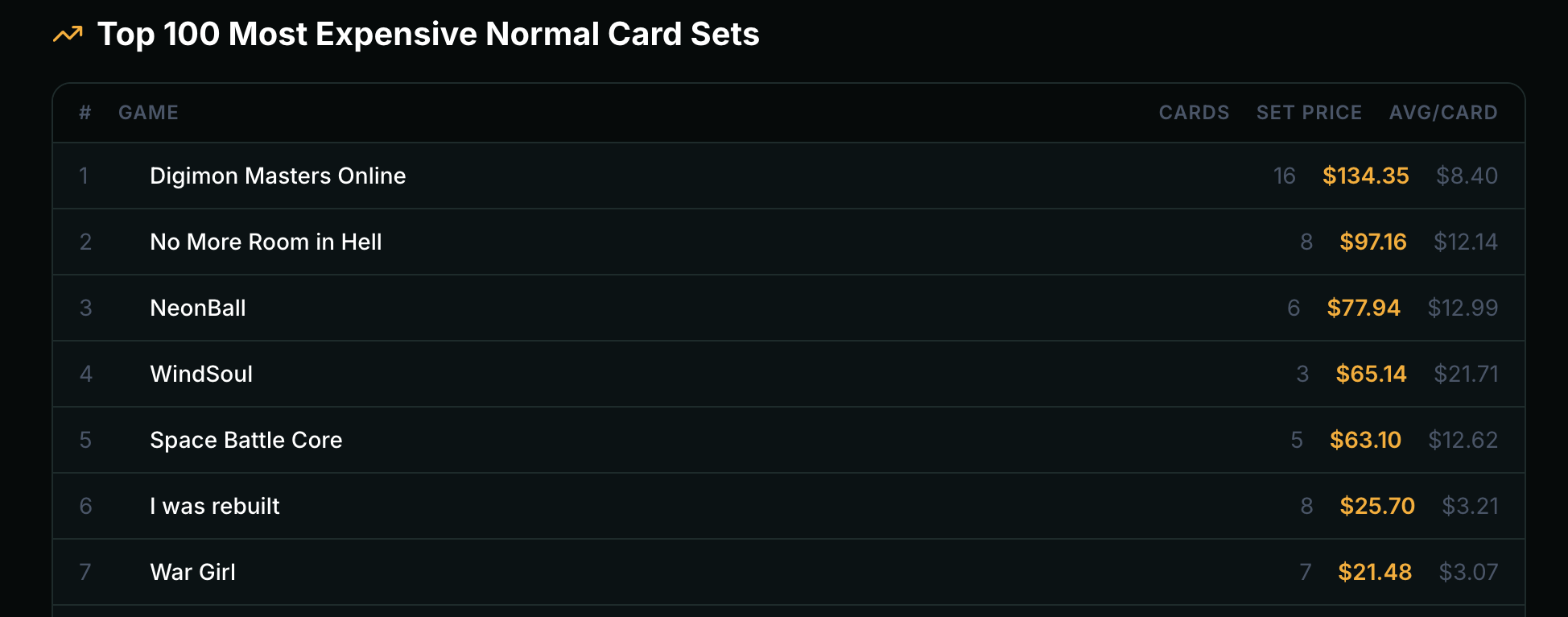
A few things stand out here. WindSoul has only three cards in the set but averages $21.71 per card — by far the highest per-card value on the list. Digimon Masters Online has 16 cards, which is a large set, and the total is still north of $130. These aren't games that were necessarily huge; they're games where supply dried up and someone, somewhere, still wants the cards.
The reasons cards go expensive are usually one of three things: the game was delisted (so no new players are generating drops), the game had very few players to begin with, or the developer never distributed many booster packs. Sometimes all three at once.
The Cheapest Steam Trading Card Sets
On the other end of the spectrum, there are hundreds of games where a full badge set costs less than a single US cent per card. The cheapest Steam card sets skew heavily toward low-player-count games that had a lot of cards generated and very little demand for them.
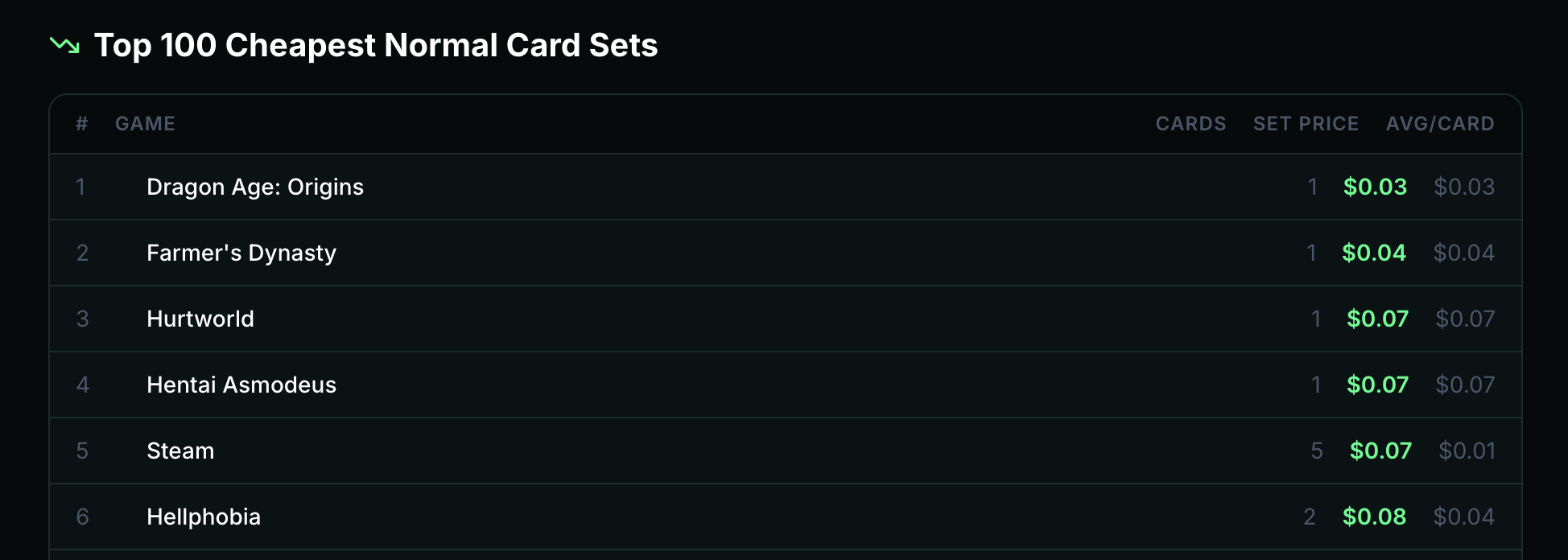
Dragon Age: Origins has one card in its set and it sells for three cents. That's the floor. Leveling your Steam account via cheap badge sets is a legitimate strategy, and the Steam Badge Cost Calculator can help you figure out which sets give you the most XP per dollar spent.
Which Games Have Steam Trading Cards?
Not every game on Steam participates in the trading card system. Developers have to opt in, and many smaller games don't bother. The ones that do are listed in the Steam store with a "Steam Trading Cards" badge on the game page.
Generally, most games from major publishers have cards, as do many indie titles. Games that were removed from Steam after launch sometimes keep their cards circulating on the market, which is part of why delisted game cards can appreciate.
You can browse the full set of games that have trading cards at showmyitems.com/steam-cards, which covers the complete catalog with card counts and current market availability.
One Last Thing About the Market
Steam's trading card economy is old. The system launched in 2013 and has received minimal updates since. Prices for most cards have been compressed by years of supply accumulation and bot farming, and the gap between the most valuable sets and the average card has only widened.
If you're sitting on a pile of cards from games you played years ago, the Steam Card Value Checker will tell you what you actually have in about thirty seconds. Some of it will surprise you. Most of it won't. But at least you'll know.
Prices reflect Steam Community Market data as of March 2025 and are subject to change.