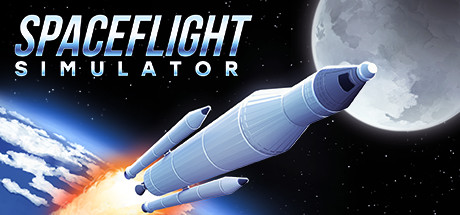
Spaceflight Simulator puts players in command of a space program, with the central challenge running from designing a rocket to reaching and landing on another world. Its appeal lies in treating space exploration as a chain of practical decisions rather than a simple trip: a vehicle must be built for its mission, its flight planned, and its payload managed along the way.
Rocket construction draws on components with distinct technical properties, including mass and aerodynamics, while engines model thrust and fuel use. Players can assemble multistage vehicles, control stage separation and time secondary burns, then navigate the Solar System and attempt landings under differing gravity, atmosphere, and terrain conditions. The game’s trial-and-error approach makes a successful landing a meaningful counterpart to the initial thrill of launch. Satellites, rovers, and space stations extend the objective beyond individual flights: the world persists across missions as players build a presence in space.
Within that format, the game pairs hands-on vehicle engineering with longer-term exploration, asking players to connect one mission to the next. Its combination of customizable spacecraft, modeled flight behavior, and planetary destinations gives each launch a clear purpose: carry out a plan, contend with the destination’s conditions, and expand what the space program can do.