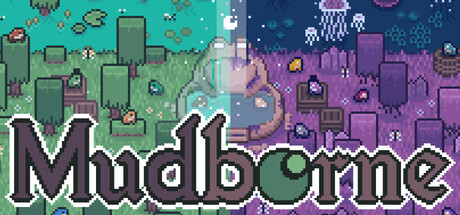
Mudborne begins with a simple loss: waking from hibernation, you find your pond abandoned and empty. This casual nature-management game makes rebuilding its frog population the central aim, pairing a quiet restoration premise with experiments in breeding. Its focus on frog genetics gives the familiar idea of tending a habitat a more unusual direction: recovery depends on discovering what new species can do.
The work moves between crafting minigames, menu management, and puzzle solving. Players modify frog genetics to create species, cultivate mushrooms with varied effects, and use frogs to uncover secrets and power machines. New genetic keys also open routes between waking and dreaming worlds, where puzzles and exploration extend the effort to restore the pond and its inhabitants. Catching bugs, including eating them, adds a playful touch to the nature-sim framework.
The game is listed as single-player, so its management and generational puzzles are framed as a solo experience rather than a shared pond-building activity. That format suits Mudborne’s emphasis on individual experimentation: breeding discoveries feed into exploration, and exploration helps reveal what happened to the abandoned habitat. The result is a focused mix of ecological restoration, genetic tinkering, and puzzle-led progression, with frogs serving as both the creatures to recover and the means of moving the adventure forward.